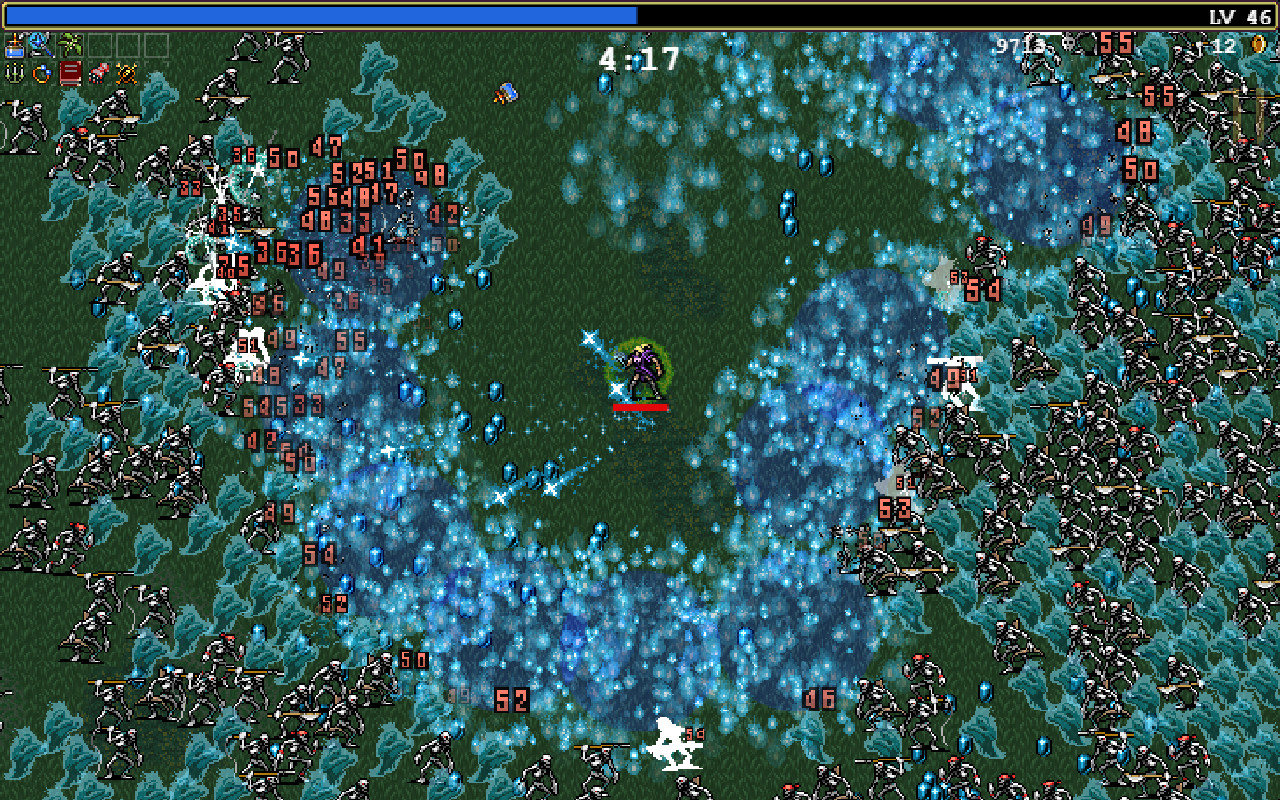
Bullet-heaven games like Vampire Survivors · Image: poncle
In 2026, building a horde survivor with AI takes roughly two hours from idea to a browser-playable run. The workflow: pick a multi-agent AI game studio with a built Horde Survivor engine, write a one-sentence brief (“a bullet-heaven where you play a caffeinated barista”), approve a concept screenshot, let the agents wire up auto-firing weapons, XP gems, and escalating enemy waves in parallel, then iterate in chat until the run arc feels tight.
This guide walks through every step, with the exact prompts and expectations you should have at each stage.
TL;DR: The Eight Steps
1. Pick a studio with a horde-survivor engine
A multi-agent studio that ships the genre template beats stitching single-tool generators together. You want auto-fire, XP gems, and level-up picks ready out of the box.
2. Write a one-sentence brief
Genre plus a hook. “A survivors game in a haunted hospital.” “A bullet-heaven where you play a caffeinated barista.” You don’t need more.
3. Answer follow-ups
The director asks about art style, run length, and starting weapon feel. Two sentences each is plenty.
4. Approve the concept screenshot
A full-scene mockup showing the arena, enemies, XP gems, and HUD locks the art direction before any sprite is generated.
5. Let the team build in parallel
Coder wires the survivor loop. Artist generates sprites and arena tiles. Sound Engineer scores the adrenaline track and SFX. They run at the same time.
6. Play the first build
Minutes later: a URL with auto-fire weapons, escalating waves, and a level-up screen. Click it. Note what feels off.
7. Iterate in chat
Type plain-language fixes: weapon spread, enemy speed, upgrade balance. The team revises and re-ships to the same URL.
8. Share the URL
Friends play in their browser. No install. Done.
The Steps in Detail
Pick an AI game studio with a built horde-survivor engine
To ship a complete survivors-like with AI, use a multi-agent AI game studio that already ships a Horde Survivor engine template. A studio with a Studio Director, Coder, Artist, and Sound Engineer working on shared context will produce coherent auto-fire weapons, XP gem logic, and escalating hordes far faster than wiring single-tool generators together. Single-tool generators (Scenario for art, Suno for music) produce assets you would still have to wire into a game engine yourself.
Write a one-sentence brief
Describe the game in a single sentence: genre plus a hook. Examples: “A survivors game in a haunted hospital where the enemies are restless nurses.” “A bullet-heaven where you play a caffeinated barista hurling espresso shots at endless customers.” Specificity sharpens every downstream decision; perfection is not required.
Answer the Studio Director’s clarifying questions
A good AI game studio will ask 2–3 follow-ups: art style (pixel-art vs. hand-drawn), run length target (5-minute sprint vs. 20-minute marathon), and difficulty curve. For a survivors-like, the director will also ask about starting weapon feel and how many upgrade picks you want per level-up. Answer briefly. The director writes a structured brief and hands it to the rest of the team.
Approve the concept screenshot
Before generating any sprite, the Artist agent drafts a full-scene concept screenshot showing the arena, the character mid-run, a wave of enemies, floating XP gems, and the HUD. This locks the visual direction. Approve it, or ask for a revision (“darker horror palette,” “more pixel-art-feel”). Every asset generated after this moment is produced against the approved reference, so the gems, enemies, and upgrades all look like they belong together.
Let the agents work in parallel
The Coder wires the Horde Survivor engine: auto-firing weapons, escalating enemy spawn rates, XP gem drops, a level-up upgrade screen, evolving weapons, and a run timer with scaling difficulty. The Artist generates the character sheet, enemy sprites, weapon projectiles, gem pickups, arena tiles, and UI elements. The Sound Engineer composes an original adrenaline loop and produces hit, death, level-up, and gem-pickup SFX tuned to the game. Character animations stay on-model and read clearly even when the screen fills with enemies. With shared context, the SFX cues fire at the right game events and the music tempo matches the intended run pace.
Play the first build in your browser
In minutes you have a URL. Click it and play the first build. It will have a real survivors loop: a starting weapon that auto-fires, enemies that spawn in escalating waves, XP gems that drop and pull toward the player, a level-up screen with upgrade picks, and a run timer. Note what feels off. Common first-build notes: weapon spread too tight, first-minute pacing too slow, gem magnet range too short.
Iterate in chat
Type plain-language revisions: “The enemies feel too slow in the first two minutes.” “Add a second starting weapon that chains lightning.” “The level-up screen needs a fourth upgrade option.” “Make the XP gems magnetic from further away.” The team revises and re-ships to the same URL. Repeat until the run arc feels tight, from the opening sprint through the mid-run power spike to the final-minute chaos.
Share the URL
When the run feels right, share the URL. Friends play in their browser. No install, no download. Post it to a game jam, share it in a Discord server, or link it in your portfolio.
Six Things That Trip People Up
Using a studio without a horde-survivor engine
Generic AI code generators will attempt to build the survivor loop from scratch on each run. A studio with a pre-built Horde Survivor engine template ships reliable auto-fire, XP gems, and escalating difficulty immediately. Check before you commit.
Overscoping the brief
“Survivors with 10 weapon evolutions, online co-op, and a meta-progression shop” will stall. “A bullet-heaven where you play a caffeinated barista” will ship. Add evolutions and depth in iteration, not in the brief.
Skipping the concept screenshot
If you let the artist generate enemy sprites before approving a full-scene concept, the art ends up as a collage of unrelated styles. A dark horror arena with cartoony pixel enemies looks wrong. Approve the concept first; every asset flows from it.
Treating difficulty tuning as a code problem
In a survivors game, difficulty is a systems problem: spawn rate, enemy speed, XP drop values, and upgrade power all interact. Describe the feeling you want (“the first three minutes should feel manageable, then it spikes”) and let the Coder adjust the curve.
Asking for 3D or thousands of simultaneous enemies
Chatforce is 2D-only and browser-only. If you need thousands of on-screen enemies at 3D scale, a custom Unity build will push further. For a 2D horde survivor in a browser tab, the AI studio workflow is faster than building a custom engine from scratch.
Stopping after the first build
The first build has the mechanics. The fun comes from iteration: tightening the run arc, adding a boss wave, tuning the upgrade pool, adjusting the music tension. The cost of a chat revision is minutes. Use it.
Tools for Making a Survivors Game with AI, Compared
Chatforce is 2D-only and browser-only. For a horde survivor in a browser tab, that’s a feature, not a limitation.
Approach
Chatforce
Rosebud AI
Single-tool stack
Claude / ChatGPT + engine
Built horde-survivor engine template
Yes, ships day one
Partial
No, build from scratch
You write it
Auto-fire, XP gems, level-up screen
Yes, in template
Partial
No
Requires prompting
Weapon evolution support
Yes, via chat
Limited
No
Manual
Multi-agent team
Yes, 4 specialists
Single model
No, per-tool
One model
Original art + animations included
Yes, consistency-locked
Yes
Per-tool
BYO
Original music + SFX included
Yes, original score + SFX
Limited
Per-tool
BYO
Browser-playable output
Yes, one URL
Yes
Manual
Manual
Difficulty-curve tuning via chat
Yes, seconds
Fast
Slow, tool-switching
Medium
Starting price
Free + bonus credits, $20/mo
Free + paid
Varies
From $20/mo
Frequently Asked Questions
Can AI make a real survivors-like game, not just a prototype?
Yes. Chatforce’s Horde Survivor engine ships the full genre loop: auto-firing weapons, escalating enemy hordes, XP gem drops, a level-up upgrade screen, weapon evolution, a run timer, and scaling difficulty. The output is a browser-playable game, not a tech demo.
Does the AI handle auto-firing weapons and enemy waves automatically?
Yes. The Coder agent implements the auto-fire loop, enemy spawn rates, and difficulty scaling from the genre template. You describe the feel you want (“tight spread,” “homing projectiles”) and the agent adjusts the parameters in code.
Can I get weapon evolution (like in Vampire Survivors)?
Yes. The Horde Survivor engine supports weapon evolution. Describe the evolved form in chat: “when the garlic reaches max level and the pummarola is equipped, they combine into the Soul Eater.” The Coder wires the condition and the Artist generates the evolved-weapon sprite.
How long does a survivors run in the AI-built game last?
The run length is configurable. The Studio Director will ask during setup. Common targets are 10–15 minutes for a casual run or 20–30 minutes for a marathon. Difficulty scaling and the run timer are both adjustable at any point via chat.
Can I add a boss at the end of the run?
Yes. Tell the team “add a boss wave at the 15-minute mark” and the Coder introduces a boss spawn trigger, the Artist generates the boss sprite sheet, and the Sound Engineer produces a boss-entry music sting. All three updates ship to the same URL.
Do I need to code the horde logic myself?
No. The Coder agent handles all game logic. You describe behavior in plain English: “enemies speed up every two minutes” or “spawn a mini-boss when the timer hits five minutes.” If you want to read or adjust the code, you can, but it is not required.
What is the one case where a traditional engine beats Chatforce for survivors?
If you need thousands of on-screen enemies at 3D scale, a custom Unity build will push further. Chatforce is 2D-only and browser-only. For a 2D horde survivor playable in a browser tab, the AI studio workflow is faster than building a custom engine from scratch.
How much does it cost to make a survivors game with AI?
Chatforce gives new accounts bonus credits, enough to ship at least one complete horde survivor across all four agents. After that, the paid plan is $20/month. There is no per-asset cost; you talk to the team and they ship.
Start Step 1 Now
Open Chatforce. Type one sentence about your survivors game. The team wires up the horde, the weapons, and the music. You play the result in a browser tab.
/icon_text_light_svg.svg)