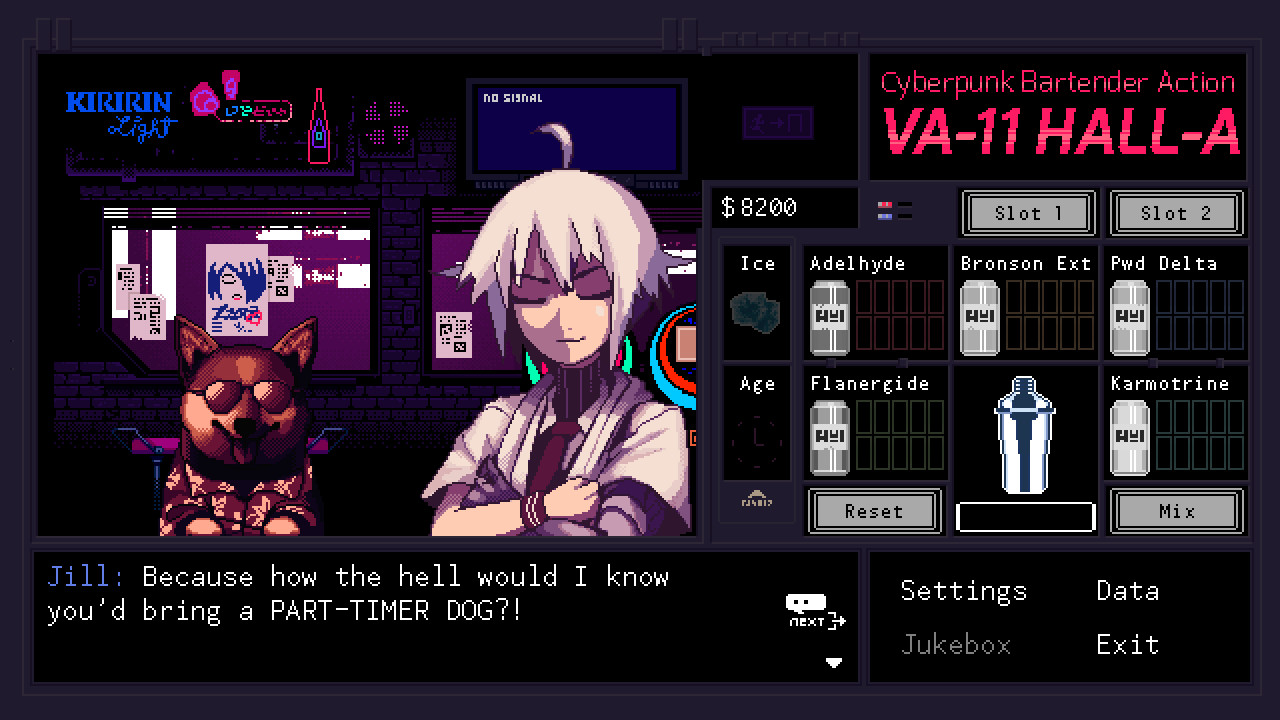
Visual novels like VA-11 Hall-A pair character sprites with a branching dialogue box · Image: Sukeban Games
In 2026, making a visual novel with AI takes roughly two hours from idea to a browser-playable build. The workflow: pick a multi-agent AI game studio with a built visual novel engine, write a one-sentence brief, approve a concept screenshot, let the agents build branching dialogue and character sprites in parallel, then iterate in chat.
This guide walks through every step, with the exact prompts and expectations you should have at each stage.
TL;DR: The Eight Steps
1. Pick a multi-agent studio
A studio with a director, a coder, an artist, and a sound engineer beats single-tool generators for shipping a complete visual novel.
2. Write a one-sentence brief
Setting plus a dramatic hook. “A visual novel where you run a haunted cafe.” You don’t need more.
3. Answer follow-ups
The director asks about art style, tone, route count, and play length. Two sentences each is plenty.
4. Approve the concept screenshot
A full-scene mockup showing the dialogue box, a background, and a character sprite locks the art direction before any assets are generated.
5. Let the team build in parallel
Coder writes the branching dialogue tree and choice logic. Artist generates sprites with expression variants and backgrounds. Sound Engineer scores. They run at the same time.
6. Play the first build
Minutes later: a URL with a real visual novel loop. Read through it. Take notes on what feels off.
7. Iterate in chat
Type plain-language fixes. The team revises dialogue, sprites, and music and re-ships to the same URL.
8. Share the URL
Readers play in their browser. No install. Done.
The Steps in Detail
Pick an AI game studio with a visual novel engine
To ship a complete visual novel with AI, use a multi-agent AI game studio that includes a built visual novel engine, not a general-purpose chatbot or a single asset generator. You need specialized agents for direction, code, art, and audio that share context so the branching dialogue, character sprites, and background scenes cohere. Chatforce ships a Visual Novel / Management Sim engine built for exactly this. Single-tool generators produce assets you would still have to wire into a script yourself.
Write a one-sentence brief
Describe the visual novel in a single sentence: setting plus a dramatic hook. Examples: “A visual novel where you run a haunted cafe and the staff are ghosts with unfinished business.” “A branching mystery aboard a generation ship where the AI navigator is lying.” Specificity helps; perfection is not required.
Answer the Studio Director’s clarifying questions
A good AI game studio will ask 2–3 follow-ups: art style (anime, painted, pixel), tone (cozy, thriller, romance), target route count, and expected play length per ending. Answer briefly. The director writes a structured brief covering the branching structure and hands it to the team.
Approve the concept screenshot
Before generating individual character sprites, the Artist agent drafts a full-scene concept screenshot showing the dialogue box UI, a background scene, and at least one character in a neutral expression. This locks the art direction. Approve it, or ask for a revision (“more painterly,” “darker atmosphere”). Every sprite and background generated after this is matched to the approved reference.
Let the agents work in parallel
The Coder implements the branching dialogue tree, player choice menus, save/load checkpoints, and multiple route logic. The Artist generates character sprites with expression variants (neutral, happy, shocked, sad), background scenes for each location, and any CG art as clean, transparent-background cutouts locked to one consistent style, so every character stays on-model across routes. The Sound Engineer scores original ambient music per scene and produces SFX for choices and transitions, all tuned to the game. All three run at the same time with shared context so the music fits the tone and the sprites match the world.
Play the first build in your browser
In minutes, you have a URL. Click it. Read through the first route. It will have a real visual novel loop: dialogue box, character sprites with expression swaps, background scenes, player choices, and at least one ending. Note what feels off.
Iterate in chat
Type plain-language revisions: “Give the cafe manager a tsundere route.” “The ghost sprite looks too cheerful for a horror visual novel.” “Add a bad ending if the player chooses wrong three times in a row.” “Make the background music more melancholy on the ship route.” The team revises and re-ships to the same URL. Repeat until the story feels right.
Share the URL
When you’re happy, share the URL. Readers play in their browser. No install, no download. Submit it to a visual novel jam, post it to your portfolio, or share it in your writing community.
Six Things That Trip People Up
Using a general chatbot instead of a visual novel engine
Asking a general-purpose AI to “make a visual novel” gives you a text outline. Using a studio with a built visual novel engine gives you a browser-playable game with sprites, dialogue boxes, and branching choices.
Overscoping the branching structure
“Twelve routes with a hundred choices each” will stall. “Two routes and three endings based on five key choices” will ship. Let the director scope you down on the first pass; you can expand after you have a working build.
Skipping the concept screenshot
If you let the Artist generate sprites before approving a full-scene concept, character art ends up stylistically inconsistent across scenes. Always approve the concept screenshot first so every asset is matched to the same reference.
Treating character expression as a cosmetic detail
Expression swaps are one of the most story-critical mechanics in a visual novel. Ask for them explicitly during iteration: “Give the navigator a suspicious expression for the interrogation scene.” The Artist generates expression variants against the approved sprite reference.
Forgetting that music sets the reading pace
The Sound Engineer scores ambient music per scene. A single generic loop for the whole visual novel flattens the emotional arc. During iteration, describe scene moods: “The cafe at opening should feel cozy; the hidden basement should feel unsettling.”
Stopping after the first route
The first build gives you one route. The branching structure, alternate endings, and character arcs that make a visual novel memorable come from iteration. The cost of adding a new route in chat is much lower than you expect.
Tools for Making a Visual Novel with AI, Compared
Comparison for visual novel creators. Chatforce is 2D-only and browser-only, which is exactly right for the format.
Approach
Chatforce
Ren’Py
Single-tool stack
Claude / ChatGPT + engine
Multi-agent team
Yes: 4 specialists
No: author-only
No: per-tool
One model
No scripting language required
Yes
No: Ren’Py script
Mixed
No
Branching dialogue + multiple endings
Yes
Yes
Manual
Manual
Original character sprites included
Yes: expression variants
BYO
Per-tool
BYO
Original music + SFX included
Yes: original score + SFX
BYO
Per-tool
BYO
Browser-playable output
Yes: one URL
Desktop + web export
Manual
Manual
Iteration speed
Seconds: chat
Slow: script editing
Slow: tool-switching
Medium
Granular script-level control
Via chat
Full control
Varies
Full control
Starting price
Free + bonus credits, $20/mo
Free
Varies
From $20/mo
Frequently Asked Questions
Can I make a visual novel with AI without coding?
Yes. In Chatforce, the Coder agent writes all the branching dialogue logic, choice routing, save/load, and multiple endings. You describe the structure in plain language and the agent implements it. No scripting language required.
What visual novel mechanics does Chatforce support?
The Visual Novel / Management Sim engine in Chatforce supports branching dialogue trees, character sprites with expression swaps, multiple background scenes, player choice menus, multiple routes and endings, save and load checkpoints, and a text/dialogue box UI. These are all live in the shipped engine.
Do I need to write all the dialogue myself?
No. You give the Studio Director a one-sentence premise and answer a few follow-up questions. The Coder agent writes an initial script. You can then edit, extend, or redirect any branch in plain chat: “Make the captain sound more suspicious in scene 3.” You can write as much or as little as you want.
Can I have multiple routes and endings?
Yes. The engine supports multiple branching routes and multiple endings. Describe the route structure you want in your brief or during iteration: “I want a good ending, a neutral ending, and a bad ending depending on which three choices the player makes.” The Coder implements it.
How are character sprites generated?
The Artist agent generates character sprites as clean, transparent-background cutouts so they composite cleanly over scene backgrounds. Expression variants (neutral, happy, shocked, sad) are generated against the same character reference to stay on-model and consistent across scenes.
Is Chatforce a good alternative to Ren’Py?
For creators who want a complete visual novel from a plain-language brief without writing a single line of script, Chatforce is the faster path. Ren’Py gives writers more granular script-level control for sprawling branching epics. If your priority is rapid, no-code creation and browser playability, Chatforce wins. If you need fine-grained script authoring for a project with dozens of routes, Ren’Py is worth learning.
What kind of music and sound does a Chatforce visual novel get?
The Sound Engineer agent composes original ambient and scene music plus matching SFX. Music is keyed to scene tone and character moments, not generic loops. You can request specific moods per scene in chat: “The hidden basement should feel unsettling.”
How long does it take to make a visual novel with AI?
A first playable single-route build typically takes minutes. A two-route visual novel with three endings takes a few hours of iteration. A more ambitious project with five or more routes and deep character development takes a weekend to a few days, depending on scope.
Start Step 1 Now
Open Chatforce. Type one sentence. The team builds the branching story, the sprites, the music. You read the result in a browser tab.
/icon_text_light_svg.svg)